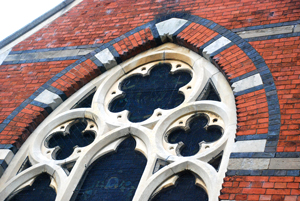
A Brief History of the Church
St. Marys as we now know it was built during the mid nineteenth
century, work started in 1860 and the consecration service was held
on 11th August, 1862. Several changes have taken place since the
completion date, the most significant being the adding of the Tower.
Wythall or Wythworth as it was previously known is mentioned in
the Domesday Book, but the first actual information available detailing
a church in Wythall was around 1330. Wythworth Chapel is actually
marked on the oldest existing road map of England, the Gough Map.
Wythworth was then on the main route from Droitwich to Coventry.
Travellers would proceed along what is now known as Radford Lane,
Hill Lane, Chapel Lane and Station Road. Various other maps detail
Wythworth Chapel. In 1576, a map mentions Wytho Chapell,
in 1577 Wythe Chap, in 1677 Wytho ChaI and
in 1763 Withorn Chapel. These curious names are perhaps ways of
abbreviating Wythworth or possibly show the beginning of a lazy
pronunciation.
The history of Wythall Chapel during the period preceding the building
of the present church is somewhat obscure. We know that during the
17th century the Chapel was in very bad state of repair. Later documentation
of 1714 and 1737 reported the roof of Wythall Chapel is out
of repair. However, in 1777, the Chapel was rebuilt.
The new Chapel was a small brick building, tiled roof with a wooden
bell turret at the West end. The internal dimensions measured 51
10 inches x 22 8. The floors were paved quarries
and the wall neatly coloured. Seven windows allowed light into the
main part of the building with additional windows in the gallery.
The Chapel was entered by a plain door on the South side. There
were 29 oak pews, one reserved for the Mynor family. The Communion
table and Pulpit were made from oak. The Gallery was reserved for
the choir and school children.
This building remained almost unchanged until 1854 when it became
apparent that it was the wish of the people of the community for
a larger and more worthy place of worship.
A committee was appointed to oversee the building. It was to be
financed by wealthy land owners together with grants from the Church
Buildings Society and the Church Extension Society. The builder
was Mr. I. Clulee of Kings Norton.
|