The Interior of the Church
The church is entered through double doors in the South wall. The
first place of interest we see on the West wall (left hand side)
is the Baptistry. The Baptistry is raised from the body of the church.
The font, which came from St. Thomas and Emmanuel, Broad Street,
Birmingham, has an oak cover which was given in the memory of the
Reverend T. G. Faulkner, Vicar of St. Marys from 1915-1933.
The old oak chest is 17th century and has been used, in past years
as a vestment chest. The Baptistry was formed in 1962 as part of
the Centenary interior reconstruction to the church. The area is
dedicated to Reverend J. S. Miller, Vicar 1933-1957 and commemorated
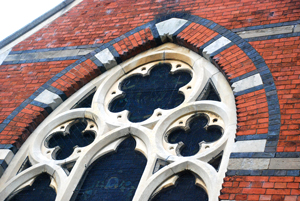
by a plaque on the West wall. The beautiful rose window above depicts
Christs Ascension into Heaven. The whole window is made up
of a circular or rose shape and two long stained glass windows.
The window to the left shows the Shepherds, Mary and the Infant
Jesus and the right hand window the Baptism of our Lord. These windows
are in memory of Richard and Esther Burman. The Victorian cross
fixed between the two long windows also depicts the Ascension with
the wording Ascend Unto My Father and Your Father and to My
God and Your God. The symbols of Matthew, Mark, Luke and John
are on each point of the cross.
Turning towards the North wall, the stained glass window given
in memory of Richard and Ann Burman, shows Jesus and the calling
of the Disciples. The left hand section shows Jesus, Simon Peter
and Andrew. The right hand Philip and Nathanael under the fig tree.
On walking down the aisle between the two rows of pews we notice
that the plain walls on the North and South help to accentuate the
intricate pattern of the red and blue brickwork of the interior
of the church. The windows in the North wall are plain leaded to
allow as much daylight as possible into the church. The main door
to the Vestries is also in the North wall just in front of the pulpit.
The pulpit is of carved stone which is reached by ascending four
shallow steps. The pulpit fall is of royal blue velvet decorated
with a gold cross and lilies. On the opposite side is the Lectern
of carved oak which is dedicated to the memory of Major Hadley.
The pillars of the Sanctuary are composed of a mixture of Bath and
Honiton stone and are carved at the start of the arch which leads
to the Sanctuary. The roof of the main body of the church is gabled
with black timber supports contrasting with the white plaster.
In the Sanctuary stands the Altar which is vested in a blue altar
cloth with a gold cross, bunches of grapes and sheaves of corn.
The Altar has only stood in this position since 1962 and was the
most significant factor in the re-arrangement of the church during
1962. The two clergy stalls on each side of the Sanctuary were designed
and made by Pancheri of Bromsgrove in 1964. The stalls are made
from oak and are carved with fruits and leaves of the oak and maple
trees. They were given in the memory of Charles Betts. The Servers
Stalls are alongside the Vicars Stall. Notice also the carvings
at the base of the arches each side of the Sanctuary. These are
believed to be the work of apprentice stone masons.
On the North side of the Sanctuary is the organ which was built
in 1908 by Nicholson & Company of Malvern. It comprises of a
Great Organ, Swell Organ and Pedal Organ with pipes from 2 to 16
feet in length. It has 58 manual notes and 30 pedal notes. The organ
case is in Pitch Pine. A doorto the right hand side also leads into
the Vestries.
Beyond the Sanctuary is the old sanctuary prior to 1962 which is
now dedicated to the Mynor family. Here the Altar is vested in gold.
The Altar reredos is carved York stone executed in the Italian style.
It has three panels; the centre depicts the Crucifixion and the
side panels, the Lamb and Pelican. This ornamental screen was added
to the church between 1862 and1875. On either side of the reredos
are panels on which are inscribed the Creed, the Ten Commandments
and the Lords Prayer which were a gift of W. H. Jackson. The
four Archangels, Uriel, Gabriel, Michael and Raphael are portrayed
in the four windows on the North and South sides. The East window
above the Altar is one of the most beautiful Victorian windows to
be found in the Birmingham Doicese. This window which depicts the
Resurrection was given to the memory of Robert Mynor a surgeon whose
home was at Weatheroak Hall (now Kings Norton Golf Club). Other
members of the Mynor family have their memorials in the Archangel
windows. The original East window is now located near the South
West entrance.
Coming from the Sanctuary into the South aisle the window to the
left depicts Mary with the Infant Jesus. Facing are two windows
showing the Good Samaritan and the Washing of Our Lords feet.
These two windows are in memory of James and Mans Johnstone and
Elizabeth Deverill. Walking along the South aisle the first window
on the left is depicting Our Lord at Gethsemene and is to the memory
of W. H. Jackson. The War Memorial is made from oak with a carved
centre panel showing the Crucifixion, the two side panels detailing
names of the fallen in World War I. The stained glass window to
the right of the memorial is very interesting as it was painted
by a former Vicars daughter, Geraldine Morris. All of the
faces portrayed depict local people of the time the kneeling figure
was modelled by her father, the Reverend Ambrose Morris. The figure
standing behind her father is Maynard Morris, her brother. Painted
with great delicacy are also wild flowers, herbs, birds and animals.
At the South West corner of the church is the book stall.
If we look around the church we will see that the Greek letters
Alpha and Omega appear five times.
- In the small lights in the East window.
- On both sides of the Chancel Arch.
- In one of the Archangel windows, St. Uriel.
- On the memorial brass to the Rev. I. C. Yarranton, which is
above the pulpit.
- In the South East corner of the nave on the memorial plaque
to the Rev, and Mrs. Mynor.
Alpha being the first letter in the Greek alphabet, The Beginning,
and Omega the last, The End.
In 1934 electric lighting was installed in St. Marys which
was a gift from Major and Mrs. Hadley. Prior to that date, paraffin
lamps had been used. The current heating system, which are electrically
heated panels under the pews were added in 1971.
Saint Marys Church has had many benefactors, the major being
the Mynor family, others have been Esther and Richard Burman, the
Field family, Major and Mrs. Hadley. Obviously, many other people
have supported St. Marys in varying ways but unfortunately
no accurate records have been maintained
|
|