A description of the church
The Church of St. Mary, Wythall, was designed by Frederick Preedy
of London, an architect with a flair for the unique. This, no doubt,
is one reason why it is of such interest to many people - let us
see the church through the eyes of the visitor
We enter the churchyard through oaken gates which were a gift of
the parishioners to commemorate the Coronation of Her Majesty Queen
Elizabeth II.
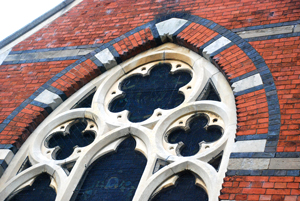
The exterior of the church is of red and blue brick, and some of
these bricks originally came from Burmans Brickyard - in what was
known as Shawcross Yard. It will be observed that there is a carved
stone cross on both the cast and west end of the church roof. The
tower which surmounts the sanctuary was added in 1908 as a gift
of the Misses Mynors in memory of their parents. The tower is in
harmony with the church and is finished with a gable roof and timber
tléche, as seen in many churches in northern and eastern France.
It measures 25 foot square and is 115 feet to the top of the flèche,
consisting of two stages rising above the nave roof, a ringing chamber
and an open belfry, the latter containing a peal of eight tubular
bells, together with an old treble bell dated 1689 - a gift from
Kings Norton to Wythall about 1889. The plans for the tower were
prepared by W. H. Bidlake. MA., of Waterloo Street. Birmingham and
the contractor for the work was Harvey Gibbs of Kings Heath. The
bells were hung by Messrs. Harrington. Latham and Co. and the stone
work was executed by Pavid French of Kings Heath.
At the south-west of the building is the main door, opening directly
onto the south aisle - and the first place we see is the baptistry.
The font, which came from St. Thomas and Emmanuel of Broad Street.
Birmingham, has an oaken cover which was given in memory of the
Rev. T. G. Faulkner (Vicar 1915-1933). The old oak chest is circa
17th century and was used, in past years, as a vestment chest. This
baptistry was formed in 1962 as part of the Centenary reconstruction
scheme and is dedicated to Rev, 1. S. Miller (Vicar 1933-1957) and
commemorated by a plaque on the west wall. Above is a rose window
of the Ascension, and two others showing the Shepherds. Mary and
the Infant Jesus. and the Baptism of Our Lord. These windows are
in memory of Richard and Esther Burman.
On walking down the main aisle v. e notice that the plain walls
of the north and south aisles help to accentuate the intricate pattern
of red and blue brickwork of the interior of the church and enhance
the pillars. composed of a mixture of Bath and Honitori stone.
The pulpit of carved stone is reached by ascending four shallow
steps, and has a pulpit fall of ro~al blue velvet decorated with
a gold cross and lilies. Opposite is thc lectern of carved oak,
which is dedicated to the memory of Major Hadley - a great benefactor
of St. Marys Church. The Bible markers are of similar material and
design to the pulpit fall.
In the sanctuary, on a deep blue carpet which was the gift of the
Womens Fellowship in 1962. stands the High Altar vested in a gold
brocade frontal. This altar has only stood here since the Centenary
and its present position was the most important factor in the re-arrangement
of the Church during the reconstruction scheme. The two oak clergy
stalls were designed and made by Pancheri of Bromsgrove in 1964.
They are carved with fruits and leaves of the oak and maple trees
and are in memory of a young Englishman (Charles Anthony Betts)
who was killed whilst residing in Canada. The Altar Service Book
cushion, worked in tapestry. depicting a white lily on a blue background
was made and given by the children of St. Mary's School as their
Centenary gift. On the north side of the altar is the organ. This
was built by Nicholson & Co. of Malvern for St. Mary's Church
in 1908 and its full specifications are to he found at the end of
this booklet.
Beyond the High Altar is the Mynors Chapel-which is now the loca-
tion of~ the choir, and was formerly the site of the sanctuary of
St. Mary's prior to 1962. Here the Altar is vested in blue velvet
which provides an excellent foil for the carved York stone reredos
executed in the Italian style. The centre panel depicts the Crucifixion
and the side panels, the Lamb and the Pelican. This reredos was
added to the church between 1862-1875. On either side of the reredos
are panels on which arc inscribed the Lords Prayer, the Ten
Commandments and the Creed. These panels were the gift of W. H.
Jackson of Glenfield.
Uriel, Gabriel, Michael and Raphael, the four Archangels, are portrayed
in the four windows on the north and south sides of this chapel.
The East Window - showing the Resurrection - replaced the window
now in the south-west entrance, and is to the memory of Robert Mynors,
the eminent Victorian surgeon who resided at Weatheroak Hall. Other
members of the Mynors family have their memorials in the Arch- angel
windows. As we leave the Mynors Chapel it is interesting to note
that carvings of strange beasts and other objects on the capitals
of the pillars in the Sanctuary.
Coming into the south aisle we see the War Memorial, made of carved
oak with a centre panel showing the Crucifixion. The two side panels
which carry the names of the fallen in World War I. give the whole
structure the effect of a medieval triptych.
The stained glass window near the War Memorial is of great interest
as it was painted by Geraldine Morris. a former Vicars daughter.
All the faces portrayed are of local people of the time, and the
kneeling figure was modelled by her father, the Rev. Ambrose Morris.
Her brother. May- nard Morris is portrayed in the figure standing
behind that of her father. Wild flowers, herbs, birds and animals
are shown executed with great delicacy. The window in the South
aisle depicting Our Lord at Gethsemane is to the memory of W. H.
Jackson. The other windows in the south transept show the Good Samaritan;
the Washing of Our Lords Feet and Mary with the Infant Jesus.
These two windows are in memory of James Johnstone (a former Vicars
Warden) and Maria, his Wife and to Elizabeth Deverill. In the south-west
entrance is another window of Mary and the Infant Jesus - which
was originally the East Window, and moved to its present position
in 1896 and this is in memory of Robert Edward Eden Mynors.
The Greek letters Alpha and Omega appear five times in different
parts of the church . . . in the small lights in the East Window
- on both sides of the chance! arch in one of the Archangel windows
(St. Uriel) - on the memorial brass to the Rev. I. C. Yarranlon
above the pulpit and in the south-east corner of the nave on the
memorial brass to the Rev, and Mrs. Mynors. The church is lit by
electricity installed in 1934 and a gift from Major l-ladley and
his wife. Prior to that dale paraffin had been used. The old hot
water system for heating was found to be inadequate and a new one
put in the church in 1956. This was replaced in 1971 by a system
of electrically heated panels placed under the pews. The door in
the north wall leads to the small office and the vestries. These
were added in 1909 as a gift from the Misses Mynors and cost £600.
In 1961. when dry rot was discovered, part of the wood- work was
replaced and the vestries redecorated for the Centenary. In 1970,
when the architect made his quinquennial inspection of St. Mary's
Church he requested scaffolding to be erected so that a more detailed
inspection of the tower could take place. This was done and it was
found that there were urgent need for repairs. Plans for the work
to be effected were put in hand and a special Tower Restoration
Fund was started in 1971.
If we go outside the church - round to the east of the vestries,
we find a small door which leads to the tower. Although the climb
up the many steps is tiring, the view on a clear day is well worth
the effort and a reward in itself.
H V F Goodger
|