The Growing Parish
The history of Wythall Chapel during the period preceding the building
of the present church is somewhat obscure. [homas Habington,1
County Historian of thei early 17th Century, describes it thus two
miles south from Kings Norton is White (WITHO) Chapela poor
thing affording neither arms nor monuments ... and in another
document2, dated 1662 we read . . . It is desired that Mr.
Richard Moores licence for that which he calls his House in Withall
(which is nothing but the curates chamber over uric code of the
chappell. and for the room adjoining (which is the chap- pell. itselfe
into which he had made a hole out of the chamber and preached to
the people) be revoked. Some of the parish registers for the
period are intact, but they give very little information. It is
from the churchwardens presentment for King~s Norton that we get
hint of the situation. In 1714 and 1737 they reportedthe
roof of Wythall Chapel is out of repair. Happily in 1777,
Nash, the Worcestershire historian, stated that the chapel was being
rebuilt.
Peter Prattinton. in 1826 gives a detailed description The Chapel
stands in a small oblong piece of ground on the left hand side of
a lane leading to the north from the crois-roads at Weatheroak Hill
and on the turnpike from Birmingham to Alcester. It is a small brick
building, tiled, with a wooden Bell turrctt at the West End. Its
dimensions internally are 51 10 x 22 8.
The Walls are neatly coloured. The ceiling flat with an Ornament
for chandeliers and the floor paved with quarries. The East win-
dow has a circular lead and the six side ones pointedthe centre
one on the north side blank. Over the East window and at the West
end are circular blank windows to give some tight to the gallery.
The entrance by a plain door with a circular lead on the south.
The West has also a semi-circular one to give some light. There
are 29 oak pews. Three on each side of the Communion Table. a large
pew f or the Mynors family at Weatheroak House. on the south. The
Communion Table and rails are old oakone step to the rails.
The pulpit is panelled oak bet~veen the first and second windows
southno sounding board. The hangings of the pulpit and Reading
Desk crimson cloth with yellow face. that of the pulpit with *.
The Pla~.e? if any, at the clerks at Ueadley Heath. Font at the
West End, an octagon wooden bason on very short pillar resting on
a brick base curbed with wood, the cover is old. Gallery for singers
and school children supported by two iron pillars painted blue.
There is only a small bell with WG MB 1689. In the upper part
of the first South window is scratched with a diamond on the glass
this chapel glazed; Win. Samson and John Burton glazed this
chapel Sept. 3rd 1777Win. Samson of Birmingham. One
seat is marked Mr. Wakefieldhe has an estate at Barnhill in
the chapelry his son does not reside here, another for Mr.
Collinshe has an estate here.
There is a school for 20 children by subscription, also a Sunday
School. The desks and forms are in place in the~ aisle and removed
for Divine Service. In the church enclosure is a Scotch fir tree
and in the hedge toward the lane several old yew trees.
There is a Methodist meeting house hear the chapel not so well
at- tended as it used to be, also a Presbyterian meeting house.
The congrega- tion at the chapel is greater than it can afford comfortable
room for.
There is about half an acre of meadow on the south sue of the church,
a house at Birchy Cross has lately been repaired -another at Drakes
Cross is repairingsome little land attached to them. Withal
Chapel House Farm about 114 acres lies near the chapel. Mr. Fitter
sold it between 32 or 33 years ago to Mr. Millington his nephew,
a grazier at Birmingham is the present possessor. (Mr. Taylor the
tenant). The Vicar of Kings Norton appoints the curate, who is licenced
and holds his cure for life. One hundred pounds were given by Mr.
Whatelythe interest paid by Mr. Carter (i~5). The rents of
the cottages were given by Mr. Collins of Worcester, amounting to
£5. The benefactions collected were £15, so that in the year 1699
the curates maintenance for Withall was £25.
A small school for about 45 children was erected near Wythall Chapel
in 1839 and was enlarged in 1892 to accommodate 14 extra children.
It is interesting to learn from the diaries of Richard Pountney
(l804~l891):~ something of the building and construction of the
school. Pountney worked for his uncle at Goodrest Farm and his diaries
show that as well as farm- ing he did odd jobs as a surveyor for
farmers, collected taxes and did the census for the district. During
the hungry 40s he helped organise and distribute
the dole. lie began teaching school at Wythall in February 1841
as the farm at Goodrest was not paying, one of the reasons for this
was the absence of marketing transport to meet the railway competition
in the areas. The following extracts are from his diaries:
The school at Wythall began June 1839 and comtileted
Jan. 1841. 8th April 1840. Fetched 1200 bricks from Mr. Pountneys
for the building. 2 doz. gutter tiles.
28th April 1840. 1 ton 11 cwt. lime fetched from Pountneys for the
building.
30th April 1840. 1 ton 15 cwt. sand fetched from Solihull Lodge.
11th May 1840. The Carpenters came to workmade 2~ days.
18th May 1840. 1 ton 10 cwt sand fetched from los. Coxes.I ton more
sand fetched from Mr. Coxes at Truernans Heath.
20th May 1840. The mason began to work.
21st May 1840. The masons at work and carpenter.
22nd May 1840. The masons at work and carpenter.
23rd May 1840. The masons at work.
29th May 1840. 1,200 gutter tiles fetched from Mr. Pourttneys.
3rd June 1840. Fetched 500 bricks, 6 roof tiles and I gutter tiles
from Solihull Lodge.
22nd June 1840. Fetched 1.200 house tiles from Kemps.
1st July 1840. Fetched 1,600 tiles from Kemps for the building.
Sunday, 10th Jan. 1841. The childrens dinner in the new schoolroom.
15th February 1841. Began teaching school at Wythall, only three
scholars.
Apart from minor alterations St. Marys School has remained
unchanged. In 1963 a new school was built at Meadow Green and the
pupils transferred to there. The Old School then came into use as
the Old School Hallwhere meetings of various organisations
connected with the church take place. The Wythall Pre-School Playgroup
use the building for their activities and have made many valuable
additions to the inside of the Hall. as have also the Young Wives
and the Womens Fellowship. Towards the middle of the nineteenth
century the consolidated chapelry of Wythall was considered important
enough to become a parish in its own right, and an Order of Council
on the 8th August, 1853 set up the Parish of Wythall, defined its
boundaries and ordered that the right of presenta- tion and
appointments of an incumbent or perpetual curate to serve the said
church of St. Mary at Wythall aforesaid should be vested in belonging
to and whenever the occasion may arise be exercised by the incumbent
for the time being of the Parish Church of Kings Norton.
The value of the living, with a residence, was £130 and was mainly
derived from land and a proportion of tithes of the three parishes
of Kings Norton, Alvechurch and Solihull. including Forshaw Heath.
The school at Forshaw Heath was built in 1847 on the land of the
Feoffees of Solihull United Charities, to serve as a dual purpose
of a school and chapel-at-ease to the Parish Church at Solihull.
Thus for 120 years it has been used for religious purposes. The
control of the school was placed by the Feoffees in the hands of
the Rector. In 1757 the spire of Solihull Church fell in a storm,
damaging the chancel. This was repaired by the RectorDr. Greenwoodwho
had it panelled in oak. The Rev. Clive Archer (who resigned the
living in 1847) had Dr. Greenwoods work removed to Forshaw Heath
School (then in the course of erection) clearly showing that the
new building was to be more than just a school. The building, and
the lands upon which it stands, are still the property of the SolihulI
United Charities.
Although the school was closed at Easter, l965~ regular church
services are still held in the building.
The new Parish of Wythall was in the Diocese and Archdeaconry of
Worcester and the Rural Deanery of Droitwichwith a population
of approximately one thousand. Its first incumbent was Joseph Amphlett
who had come to the district in 1824. He was succeeded in 1854 by
Lancelot Capel Bathurst. MA., who soon sensed the wish of the people
of the community for a larger and more worthy place of worship.
Consequently on Easter Mondayl7th April. 1854. a meeting of
the householders of WythalL took place in the vestry. There are
no detailed records of this meeting. but without doubt, it must
have been called to discuss the future development in the parish.
In 1859. Thomas Cook Yarranton. M.A.. became Vicar of Wythall.
A typical country gentleman of his day, he rode with the Warwickshire
I-founds on his well-known cream-coloured mare. He was a bachelor
and one of the best chess players in the Midlands. During the next
six years of his incumbency the Vicarage was built, and in 1860
the Church yard opened. Before that date, all burials were at Kings
Norton. Coffins were carried there by bearers, and youths used small
stools on which to support the coffins whilst the bearers rested.
The next step was to provide a new Church. On 21st May, 1860 a
further meeting of the householders was called to consider the means
of raising funds for this purpose. The circular describing the project
was printed and distributed to all householders in the parish .
. . a statement was issued
St Marys Church, Wythall
The present church ... now affords very inadequate accom-modation
, . . it is. moreover, in a very dilapidated condition and altogether
is a building utterly unworthy for the worship and service of God.
It is intended to reconstruct upon the old site, a new Church .
. . at an estimated cost of £1,500..
The committee appointed to oversee the building was the Rev. T.
Yarranton. R. Mynors. Esq. (Robert) and Mr. Richard Burman. The
history of St. N4arys had begun I Unfortunately with the exception
of the architects plan and specification, no details of the building
of the church are available. The architect was Mr. Frederick Preedy
of London. who had designed a number of other churches and had also
made a design for Montreal Cathedral. The builder was Mr. Isaac
Clulee of Kings Norton. The cost of the church was to be £2.000
and was to seat 352 persons. It was to be financed by wealthy land
owners plus grants from the Church Building Society and the Church
Extension Society. It is recorded in the Court Rolls of Bromsgrove
in 1861 that a Bazaar was held at the Lckey for the re-building
of St. Marys Church. Wythall by kind permission of Baroness
Windsor. £200 was raised.
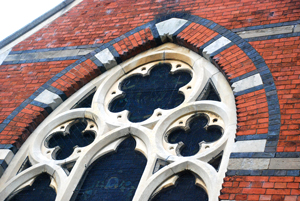
Sir Nikolaus Pevsner in his book Worcestershire published
in 1968, writes of St. Marys Church it is in an aggressive
style in- spired by Butterfield. Red brick with black brick and
stone pattern. The brick is exposed inside as well. The jambs of
windows and arches inside are emphasized by saw tooth cutting. The
pier canals inside have Early French Gothic Foliage. Flate E. end.
1. transept. S. aisle.
In August 1862, the new church was complete, and on Monday 11th
August, the Consecration Service was held, commencing at 11 am.
And continuing until 2.0 p.m. The Birmingham Daily Gazette of Tuesday.
12th August. 1862 reported that The Church was quite filled
by decently I dressed a~nd well behaved villagers and their w~althier
neighbours. The Lord Bishop of Worcester preached~ on I Kings 9;
3 c under- stand that the Bishop with clergy and visitors afterwards
par- took of a luncheon at the school, but as our representative
was unable to obtain any information from Rev. Mr. Yarranton on
the usual corttplimentary invitation ItO the luncheon. we are not
in a position to state what transpired there. An afternoon
service was held on the same day. The congregation was not nearly
so large as in the morning but an excellent sermon was preached
by the Rev. H. Clarke, Rector of Northfield. who took for his text.
Jeremiah 51; 5. The c~llectioti at the morning service was
£49.9.2d. and at thel evening service £7.l5.~7d.
Probably due to some mis-calculation on the part of the architect.
St. Marys has always been dark and the following extract from
Rambles and Researches amongst Worcestershire Churches
by G. K. Stanton tells of the impression that the buildingnot
to mention certain of the staffmade upon the visitor...
As a rambler and searcher after old churches, manor houses
and interesting ruins it has been my (mis)fortufle to travel in
strange weather. I have, for the purpose of furthering my re- searches,
walked in the heat and coldin the light and in the dark, but
my journey to Wythatl on Sunday morning 2nd Novem- her. 1884. crowned,
in the sense, all my previous perambulattons. The break in the clouds
towards the south at 8.45 am, led one to hope that the rain, which
had been falling, would speedily pass over, and so, hopefully, I
left my home, but was doomed to disappointment. When 1 arrived at
Kings Norton Station. aboUt fOur miles from Wythall, it was still
raining and con- tinued~ a steady downpour during the whole of the
day. How- ever. onwards I went, and arrived at the Church. entering
the building during the reading of the psalms~ for the day. The
service like the weatherwas dull and heavy~ the building
was over- heated and so dark that the pulpit candles had to be lit
to enable the clergyman to deliver his serrtton. The responses were
led by a clerk who is over 80 years of age and has held the ap-
pointment for upwards of 30 years. The sexton, entering the pLllpit
with his box of lucifers for the purpose of lighting the candles
and failing in the first~ attempt. reminded me of an old Church
in Herefordshire.
The incumbency of the Rev. 1. Yarranton was terminated amidst considerable
publicity given by the Redditch Indicator in the edition of Saturday.
19th November. l8~7
The series of scares which have recently occurred in the
quiet neighbourhood of Wythall reached a climax on Monday morning
when it was reported that the vicar of the ecclesiastical parish
the Rev. T. Yarranton. M.A. had been found dead in bed. Mr. Yarranton
was, until quite recently. a hale and hearty old gentleman of upwards
of seventy years of age, but during the past six months his friends
have noticed a decided change for the worse in his appearance, as
though he was gradually breaking up. His illness has been aggravated
to a great extent by the recent robbery from a cottage nearby the
Vicarage by one of his own female servants, Mary Jones. who is now
in Worcester Gaol for the crime. This girl has been in the Viears
employ for seVeral years and was considered a most trust- worthy
servant, so that when she was convicted of house- breakiti~. the
shock to Mr. Yarranton was so great as to seriously affect his healthhe
being a sufferer from heart disease. The deceased had been under
medical treatment from Dr. J. P. Gaunt of Alvechurch for a considerable
time and although he was in Church twice on Sunday last, it was
known that his condtion was very serious. When the reverend gentlemen
did not come down at his usual time on Monday morning and no response
was received to calls, the bedroom door which was locked- was burst
open and the reverend gentleman was found to be quite dead. apparently
having died some three hours pre- viously, Dr. Gaunt certified that
death was caused by heart disease, there was, therefore, no inquest.
The Rev. T. C. Yarranton had been Vicar for upwards of 30 years.
having come there from Beoley. and was unvcrsally respected by his
congregation and everyone with whom he came in contact. Great regret
is expressed in the neighbourhood by his death.
During the next four years St. Marys had two Vicars, the Rev. W.
Cotes. MA., who served from 1888-1890 and the Rev. Knapton from
1890- 1892. During this period a seventeenth century bell was given
to the parish from Kings Norton. This bell hung in a small tower
and was later re-hung in the present tower. Little progress seems
to have been made during this period, but some concern was felt
about the church finances. for in 1889 the first record of church
accounts appear in the Vestry Minute Bookthe balance in hand
being £12.3.lld.
In 1889 Wythall Institute was erected by public subscription, for
entertainments and concerts. It was endowed by the Mynors family
with £1,800 consols producing £45 yearly, stock being in name of
the administrative trustees.
In 1892 a new incumbent arrived the Rev, Ambrose Morris. who was
the son of Sir Samuel Morris of Bally Bregan Castle. Tralee. and
who had previously held incumbencies in Guernsey and Old Charlton.
He was a married man with definite family interests. his presence
was impressive for he wore a full beard. heightening his aesthetic
appearance. Mr. Morris was evidently a good admnistrator. for he
immediately set about putting the affairs of the parish in order.
On Easter Tuesday. 1892 he convened the first publicly announced
meeting of the parishioners since 1860. This meeting was held at
12 noon on 19th April. for the purpose of electing churchwardens
for the ensuing yearand for auditing the church accounts.
At this meeting the election of churchwardens and other officers
was carried through without comment, but when the church- wardens
accounts were examined it was found that on the expenses of
the previous year there was a deficiency of £6.1 .3 together with
two out- standing bills (unpaid) of £16.l.8d.. making altogether
£222.1 Id. At the next Vestry Meeting on 17th April, 1893,
the churchwardens resigned apparently without giving notice to the
Vicar, The meeting was therefore adjourned until 24th April when
the Vicar nominated Sir James Johnstone as his Warden and the Rev.
R. H. Mynors (of Weatheroak) was unani- mously elected Peoples WardenThe
Church Accounts were examined. audited and passed. the outgoing
churchwardens clearing off all debts; Sir James Johnstone and Rev.
R. H. Mynors subscribing £1 each towards expenses of the ensuing
year.
After this initial storm the parish settled down under its new
Vicar. In 1895 it was decided to improve and enlarge the church
organ. which work seems to have been executed and the second manual
being added On 13th June. 1895. the Vicars Warden. Sir James Johnstone
died sud- denly. haxing been thrown from his horse near Fulford
Hall. A stone commemorating this event is to be seen today near
the site of the accident. Mr. 1. Burman was appointed in his place.
but at the next Vestry meeting the Vicar had once again to refer
to the sudden death of his Warden. There seems to have been some
difficulty in getting anyone to serve as Vicars Warden over the
period of the next few years. and an appointment to this oflice
was not made until the last year of Mr. Morriss incumbency.
At the last Vestry meeting with the Vicar in the chair, regret was
expressed at the death of the Rev. R. H. Mynors (Churchwardefl for
thirteen years) and also of the death of MrS. My furs. The offi~c
of ehurchwarden was, however, kept within their family, for Miss
Florence Mynors was elected Peoples Warden in succession to her
father. It was also announced at this meeting that the Sunday morning
offertory was to be discontinued and replaced with a monthly collection
morning and evening.
On 13th January. 1905 the Diocese of Birmingham was founded. Its
hrst Bishop. the Right Rev. Charles Gore. M.A., was enthroned in
the Cathedral on 2nd March, 1905. Bishop Gore was a well-known theologian.
The new Diocese of Birmingham was comprised of the Rural Dcaneries
of Birntiitgham City. Solihull, Edgbaston. Handsworth. Moseley,
Smeth- wick, Aston. Bordesley, Coleshill. Polesworth, Sutton Coldfield,
Yardley and Kings Norton. the latter which included the parish of
St. ~4ary, Wythall.
The Rev. Arthur Phclips M.A. (OXon) became Vicar in 1907- Ambrose
Morris having resigned the living in 1906. Mr. Phelips had previously
held curacies in Balsall Heath and Kings Norton and scrved as a
minor Canon of Worcester Cathedral. Also, in the same year, Miss
Burman gave a stained glass window to be placed in the north wall
in memory of her parents.
St. Marys Church was still without a to~ver but in 1908 the Misses
Mynors proposed to give a tower to the church as a memorial to their
parents, It was agreed that this msgnificent and generous
offer be cordially and gratefully accepted Thc. tower was to be
in harmony with the church and to be finishLd with a gable roof
and timber flôche, as seen in village chttrch~s in northLrn md eastern
France. It xvas to be ~S foot square and 115 feet to thu top of
the flâche. consisting of two stages rising above the nave roof-a
ringing chamber and an open belfry containing a peal of eight tubular
bells. The plans were prepared by Mr. W. H. Bidlalke. MA.. of 37
Waterloo Sinreet. Birmingham. and the contractor for the work was
Mr. Harvey Gibbs of Kings Heath. The bells were hung by Messrs.
Harrington Latham and Co. and the stone work was executed by Mr.
David French of Kings Heath. Here again we quote from Sir Nikolaus
Pevsners WorcestcrshireX
The splendid central tower of 1908 .,. it is very high. of
darker brick and its tipper parts all open zSO that one can see
through ii. On each s~de are two very high two-light openings. richly
shafted. The top is a saddlcback roof with an odd flêche in the
middle and an equally odd polygon stair4urret running up one corner.
The inspiration comes from C.l3 in Normandy. The design is of a
high quality~and is indeed W. II. Bidlake.
The building of a new vestry was also considered and a stained
glass window commemorating the ministry of Rev. Ambrose Morris.
At a Vestry Meeting in 191)9 th~ Vicar stated that this past
year has been a remarkable one in the history of Wythall Church.
in that it had seen the completion of the church by the addition
of la tower and the addition of new vestries. unfortunately,
extensive dry~ rot1 had been discovered in the organ. and it was
decided that the existing instrU- ment would have to be removed
and ai new one installed, the cost of which was to be covered by
public subscription. There was little delay in raising the money
and a new organ was erected during the winter of 1909. The Morris
memorial window, suggested earlier, was also completed in 1910 and
installed in the south aisle.
St. Francis Church. Hollywood. was opened in 1910 as a result
of a Church Army Mission in lthe area and thrived under the~ leadership
of a number of Church Army captains for the next thirty years. In
1913 a church room was built at Batemans Green. Hollywood on land
given by Miss Florence Mynors. The owners were the Birmingham Diocesan
Trustees. the Vicar of Wythall being the administrative Trustee.
In this same year Mr. Phelips discovered in the living room of the
Head Teachers house at FOrshaw Ueath School. a valuable Jacobean
Holy Table, which in or about 1847 was removed from Solihull Parish
Church and presented by the Rector of SolihulI to Forshaw Mission
rooms. It was reported several years later that this Table has now
been restored to its proper place in the church rooms, and
it has been in regular use at Holy Communion since that date. During
the seven years of Mr. Phehps ministry at Wythall the social life
of the parish was developed considerably. and one of the highlights
of this period were the garden parties held at Weatheroak Hall.
In 1915 the living was taken over by the Rev. Thomas Faulkner.
who appears to have been something of a perfectionist. His special
breakfasts at the Vicarage after Ascension Day Holy Communion are
still remembered by some of the older inhabitants of the parish.
When- ever he went visiting he was always accompanied by his large
dog.
With the coming of aerial warfare, some concern was felt for the
preservation of the church tower against low-flying aircraft, and
the churchwarden. Miss I-. Mynors. took out an insurance to cover
this. At this time a gift of a piece of land for the erection of
a Church School at Batentans Green. Hollywood was made by Mr. Howard
Shuttleworth of Gravelly Hill, Erdington. Building has never taken
place on this site, but income from its letting is retained by the
Vicar and Church- wardens for church purposes. A special meeting
of the Vestry held on Monday 15th D~zember 1919 decided upon the
design of a war memorial. which was placed on the south wall during
1920.
Throughout the whole Church at this time therc was a growing movement
towards placing great responsibility upon the shoulders of the lty-pcoplc
and so. in the Church of England. representation by the laity was
brought about by the provision of the Enabling Act, which ordered
that each parish should have a Parochial Church Council elected
by the parishioners. The first election of the Parochial Church
Council of St. Marys took place at Wy[hall Institute on Tuesday
13th April. 1920 at 7 p.m. Twenty-four parishioners were present
and the Vicar presided. The follo~ving people were elected to the
first Parochial Church Council
Mrs. Archer Mr. Lycett
Mrs. F. Baker Mr. A. Martin
Mr. Batchelor Mr. Mullev
Miss Burnham Miss Mynors
Mr. Cooks Mr. W. Newman
Miss Cooks Mr. Perks
Mrs. Darby Mr. W. D. Richards
Mr. W. Dodd Mrs. Richards
Mr. W. Fletcher Mr. M. Savage
Mr. A. 1-tandy Mr. W. Thorpe
Mr. Hughes Mrs. Thorpe
Mrs. Kinnersley Mrs. Vernon
In 1933 the Rev. I. G. Faulkner retired from active ministry, although
he continued to live in the parish, and was succeeded by the Rev.
J. S. Miller. BA.. a graduate of Trinity College. Dublin. who was
instituted in the same year. after a curacy in Kings Norton preceded
by many years as a missionary and teacher in China. Up to this date
St. Marys had been lit with paraffin lamps necessitating a great
deal of regular maintenance, but in 1934. through the generosity
of Major Hadley and his wife. a system of electric lighting was
installed. The hot water system was replaced in 1935 by a new system
of hot air heating {which was later found to be inadequate) and
a new hot water system was installed in 1956.
In January 1939 the Royal Air Force Station at Wythall was opened.
This began as a balloon barrage centre and later became a training
school for interpreters and wireless operators. It was built on
the site of Yew Tree Farm. which was demolished to make way for
the station.
St. Marys had a parish magazine dating from the middle of the nineteenth
century. but in December 1940. because of War conditions it was
found necessary to discontinue this publication. The question of
resuming this ~as discussed in 1949 but it was decided to be too
costly. Church fabric maintenance had caused the Parochial Church
Council considerable concern for many years, so in 1949 a restoration
fund was launched and during nine years raised over £1,000. On the
occasion of the Coronation of Queen Elizabeth 11. 2nd June. 1953,
the whole of the community subscribed to a pair of oaken gates-which
were dedicated by the Rev. F. 6. Ashford, Vicar of Kings Norton.
After holding the incumhcncy of Wythall for twenty-four years,
the Rev. J. S. Miller died in October 1957 and was succeeded by
the Rev. C. F. Sharpe, the present incumbent. Before coming to Wythall,
Mr. Shaipe had served as a curate in Falkirk. Scotland and at Kings
Norton and had studied for the ministry at Ednburgh Theological
College. He was also appointed Chaplain to the R.A.F. until the
closing of the station in October 1959.
At his institution by the Lord Bishop of Birmingham, the Rt. Rev.
John Leonard Wilson, C.M.G.. M.A.. l).D., on Sunday 8th February,
1958. the sermon was preached by the Suffragan Bishop of Aston,
the Rt. Rev. Clement St. Michael Parker. MA. Two Rural Deans were
present and the Vicar was presented by the Vicar of Kings Norton,
the Rev. F. G. Ashford, M.A.. who was patron of St. Marys.
The Vicarage was obviously in need of drastic renovation and modern-
isation before it could be occupied. Negotiations were immediately
begun with the Diocesan Authorities together with the Church Commissioners
and a scheme was drawn up. The work ~ not completed until November
1958, the Vicar and his family living in a caravan in the vicarage
garden. and using the garage as a study. during the interim period.
Within the first five years of his arrival the Vicar began plans
for the Centenary of St. Marys Church in 1962. The Restoration Committee
was disbanded and the St. Marys Centenary Appeal Committee
formed. The more ambitious plans for the parish required financial
backing and a scheme of planned giving was inaugurated in November
1958.
A Youth Group (the Younger Generation Group) was begun under the
leadership of the Reader, Mr. P. Hudson. and the womens activities
were re-organised under the name of the Womens Fellowship
(which superseded the Mothers Union) with its Founder-President,
Mrs. N. Parker. Later, a further wornens group for Young Wives was
formed and a branch of the Church of England Mens Society inaugurated,
also 2 band of people specially interested in the history and improvement
of the church were formed into the Guild of St. Mary, Wythall.
It was discovered that the Mission Church at Hollywood (St. Francis)
was in such disrepair that its use for worship was impossible. Accordingly
the Parochial Church Council recommended that this church be closed
down and the Bishop cancelled the Licence on 13th February, 1959.
In September 1959 a new Parish Magazine appeared-the Wythall Mes-
setiger-which served its purpose until Christmas 1960 when St. Marys
Journal came into being.
There had been no confirmation services for twenty-nine years at
St. Marys and much joy was felt when the Bishop of Birmingham. the
Rt. Rev. J. L. Wilson, officiated on the 15th December, 1959. confirming
some forty people.
The first architects report on the condition of the church was
received in March 1960 and revealed that at least £5000 was required
to put the building in order. The remaining building at Hollywood.
St. Francis Church Hall. was also found to be in bad repair. As
it was mainly used by the Younger Generation Group the Parochial
Church Council decided that it should be regarded as a Youth Centre.
In consequence, the young people themselves immediately began a
programme of repair. renovation and modernizing of the building.
On Sunday 5th February. 1961. the Bishop of Birmingham celebrated
Holy Communion at St. Marys. This was the first episcopal administration
for seventy-five years.
Application for a Faculty to make alterations and improvements
to the interior and exterior of the church were made and received
in 1961 and the work commenced accordingly. The Vicar inaugurated
a Birthday Gift Fund~ and £550 was raised by the end of the year.
During the Centenary celebrations in 1962. many special services
were held. Most outstanding was the Centenary Re-Dedication Service
at II a.m. on Sunday. 30th September. when the Bishop of Birmingham.
the Rt. Rev. J. L. Wilson. blessed the Baptistry, the newly-arranged
Mynors Chapel and the Sanctuary. The Vicar preached at a Festival
Evensong and during the following week there was a Youth Service
and Party- an Organ Recital and a childrens Parity at Silver
Street School. An Exhibition of the History of Wythall and St. Marys
Church was opened in Woodrush School on Saturday 6th October by
Charles Parrish, Esq. of the Birmingham Library. and this proved
to be of great interest to people from far and wide. The local newspapers
carried reports and photographs of the exhibits. A 13 foot high
scroll showing all~ Ehe dates of Importance relevant to Wythal]
from as far back as 849 AD. was supported by maps and documents
sketches-photographs, etc. There were many other fine exhibits including
a Missionary display-old news- paper cuttings-old photographs-paintings
by local schoolchildren, and visitors were able to watch the special
edition of St. Marys Journal being duplicated and assembled. All
organisations in the parish were represented and it was with much
regret that the Exhibition closed down on Sunday evening. 7th October.
The Bishop of ~ston (Rt. Rev. D. B. Porter) preached at a s~,ecial
Harvest Festival Service on Sunday evening and in the ensuing week
there was a Womens Fellowship Servicc (at which the preacher was
the Rev. John Morris. Vicar of Longbridge) and a Community Service
when all denominations in the district joined in worship at St.
Marys. The choir at this service was composed of the Wythall Singers.
and Canon Bryan Green (Rector of Birmingham) preached a memorable
sermon. Towards the end of the month the Celebrations were concluded
with a Car Treasure-Hunt----which was rotinded off with a hot supper
in Wythall Institute.
The Rev. 1. S. Miller had stated in 1945 that churchyard space
would only be sufiicient for about another 12.18 months and the
Parish Cmmncil accepted the responsibility fOr providing a further
burial ground. Even- tually, after many disappointments regarding
sites and costs. etc.. a piece of land at the corner of Middle Lane
and Chapel Làné was purchased after a public meeting had approved
the site, scheme and e~enditure. Further delays arose, but at last
in October 1962 planning permission was granted and in April 1963
a tender for laying out was accepted. The first phase of development
was over 2~ acres, with space for 646 single graves and the rest
of the ground to be retained for use in future years.
Wvthall House and estate-comprising 374 acres of grounds in Silver
Street and beyond. was purchased by Wythall Community Associa- tion
in 1965 and opened in August 1966 as a club for local residents.
It has many very valuable amenities and there are plans to build
a Community Hall in the near future.
In 1967 a movement called lnterchurch was founded in Wythall- at
the urgent insistence of a number of people who felt that they must
seek areas of agreement between themselves, and whilst recognising
differences, examine them rather than merely reiterate them. Much
of the first year was taken up with an act of charity and service
and 1967 saw the strengthening of the previous arrangements for
the interdenomina- tional effort of Christian Aid Week. In January
1969. Interchurch organ- ganised its first service in conjunction
with the Week of Prayer for Unity. Following years have seen many
developments and a number of services have been held in churches
Of variOus denominations, which many members of lnterchurch have
attended.
The Parochial Church Council inaugurated a policy of Churchyard
Maintenance in 1969 and this involved the levelling of many graves
and removal of damaged kerbs etc.
A Diocesan policy regardittg Vicarages of over 100 years old, noss
affected St. Marys Vicarage and in 1970 the Chapel Lane Vicarage
was sold and the Vicar and his family moved to a house at 27 Lea
Green Lane which had been purchased for the new Vicarage.
Weatheroak Hall and its estate-near the top of Weatheroak Hill
-was purchased by Kings Norton Golf Club in 1970, as they had sold
their old course (or building land. The Hall was extended-a Bar
and restaurant built and a great deal of work done on the estate
to make a very splendid Golf Course up to Thternational Standards.
This was opened in 1971 when many well known professional golfers
and stars of entertainment took part in a tournament to mark the
event.
A vergers Staff, made of brass and believed to be more than 100
years old, was found behind the organ at St. Mary's Church in 1971.
When discovered, it was black with dirt and appeared to he merely
a stick. After intensive cleaning it was shown to have the letters
SM. on its head and it is most probable that this was the original
verge of the church-carried in ecclesiastical processions and used
as the vergers staff of office. It is now used at Festival times
and special occasions.
There are four good schools in Wythall and the oldest one in the
records was Silvermead. This began its life in 1883 as. Silverr
Street School and before that it was housed elsewhere as Kingswood
(Board) School. Prior to 1911 the school was administered by Kings
Norton and Northfield U.D.C. and after that date came under the
Worcestershire County Council. Originally the school catered for
children of all ages. but when the Woodrush School opened in 1957.
the older children were transferred there and Silvermead School
now caters for the 7-Il year age group. of which there are about
S5() on its roll
Woodrush County Secondary School was httilt in Shawhurst Lane and
was opened in 1957. The school has its own swimming pool and many
special rooms for the study of individual subjects. It is administered
by the Worcestershire County Council and in 1972 it became Woodrush
High School.
When Meadow Green School opened in 1963 it took over all the pupils
from the old St. Mary's School. but as time progressed the numbers
swelled alarmingly and it was then decided to build a ness Primary
School. A site was found in Shawhurst Lane and the school - called
Shawhurst Primary School - was eventually opened in 1968.
A parish history deals, of necessity. with outstanding events.
h must not be forgotten, however, that behind the events recorded
thcre is the constant, faithful Witness of the people of the parish.
Without them there would be no history. This book is more than -a
record of the beginnings of the Church history in Wythall and its
development. It is intended to inspire the people of this and ftiture
generations who worship at St. Marys to strive for greater things
in the years to come.
C F Sharpe and H V F Goodger
- Survey of Worcestershire by Thos. Habington,
edited J. Amplett, W.H.S. 1899. Vat. II. p. 218.
- Calendar State Papers 1661-2. p. 613.
- WCBO 4419.
- Buildings of England. Worcestershire. Sir Nikolaus
Pevsner, pp. 337-538
|