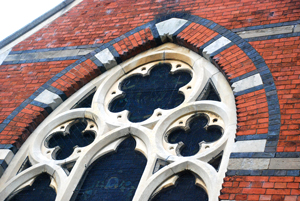
Wythall and the early non-conformists
A vast literature, led by Max Weber and R. H. Tawney, has grown
up on the Connection of Puritanism, Capitalism and the rise of industry.
Birmingham. it can be safely said without taking sides in the controversy.
was a haven of non-conformity from the first; from its suburbs of
Edgbaston and Deritend came one of the first martyrs of the Reformation
(Humphrey Middlemore-l535) and the first martyr of the Counter-Reformation
(John Rogers-I 553). One of the great gaps in the literature of
dissent (both Roman Catholic and Puritan are adequate histories
of the smaller chapels- Of-ease, which, from their comparative freedom
from ecclesiastical control, became Centres of non-conformity. Edgbaston.
dominated by a Catholic family, was for a time, the headquarters
of the Franciscan missiOn in England, whilst Deritend. Moseley.
Wythall and Oldbury became Presbyterian centres.
John Uall M.A. (1600-1653), vicar of Bromsgrove 1624-1653. served
Kings Norton himself until 1640. Adjoining Kings Norton Church
is the old timber-framed Grammar School to which John Hall appointed
his younger brother Thomas in 1629. Johns expulsion was ordered
in 1643 on fictitious grounds!~of absence;~ probably his real offence
was Puritanism. However, he continued his activc ministry until
his death.
Thomas. born on 22nd July. 1610 at St. Andrews, Worcester, where
his father was a clothier, took his BA. in 1629 from Pembroke College.
Oxford. The Grammar School which he took over at the age of nineteen
was of ancient foundation. hut almost unknown until that time. Hall,
during his all too brief life, made it famous throughout England.
After his death in 1665, it sank into neglect. A flourishing municipal
Grammar School now bears the same name, but is not in law the same
foundation.
Thomas Hall wrote an autobiography (Birmingham, Reference Library,
Photostat 467148) as yet unpublished, from which we learn that he
was curate-in-charge at Wythall from 1632-1635, at Moseley from
1635-1640 and Kings Norton from 1640. (In passing, this list
provides useful indication of Wythalls status). All through
the earlier period he was presumably living at Kings Norton.
where he taught in the week, riding on Sundays to the chapels. Week-day
services were rare, even among the Puritans.
"Many of his scholars have proved able Ministers of the Gospel
as one of them wrote (R. Moore. A Pearl in an Oyster Shell
p.77 1675). His main interest was his Sons as he liked
to call them; a bachelor, he enrolled all the most likely local
lads in his school and sent them on to Oxford. At Kings Norton
they had the benefit of llalls fine private library, bequeathed
to the parsh at his death and now contained in twD large cases in
the main Reading Room at the Birmingham Reference Library. A fine
copy of Calvins Institutes in Latin sets the tone for a collection
sufficiently Catholic to include Torquemadas Questions but wth a
general Puritan bias. The sermons of most of the Jacobean Puritans
arc represented. Hall was a bibliophile in the Cirolier tradition;
his binding stamp T.H. is on nearly all the collection.
His sons returned from Oxford, needed training in the
Ministry. rheological Colleges in the modern sense did not exist,
But Hall built up a circle of Puritan patrons in many parts of England
who took his sons for a year at a time at their various
chapels. Near at hand was Sir Richard Grevis of N4oselcy Hall and
1-Jail gives a long list of his Chaplains. No such list survives
for Wythall, and we do~not even know for certain who prosided the
income. John Field of Weatheroak Hill, gentleman. was presented
for refusing to come to Church. Henry Field (l6l-1661),
a son of Hall may. in 1664. have been a relative. Unfortunately
there were at least three other Field families of gentry in the
parish, and Richard Moore. another son settled at Weatheroak.
It seems probable that the Fields provided the necessary supplement
to the miserable few pounds of medieval endowment~ to support a
full-time Curate at Wythall. The only names recovered are in the
list at the end, but little information, except in one case, survives
about them.
Thomas Hall was awarded a B.D. in 1652. no doubt for his two books,
the Pulpit Guarded-1651 and the Font Guarded l65~ the former
(of which a fine copy is in the writers own library) dedicated to
his parishioners at Kings Norton, and the latter, the first
book published in Birmingham, is dedicated, appropriately to that
city. Together they form a textbook of high Presbyterian
theology, comparable to the writings of his friend and neighbour,
Richard Baxter, in moderate PresbyteriafliSifl. The Act of Uniformity
1662 caused his ejection together with one-fifth of the parish clergy
of England. He defied the law by refusing to leave the parish and
died, it is said, of a broken heart in Kings Norton at 4 p.m.
13th April 1665.
Some twenty-four of the ejected ministers settled in or near Birmingham
and one of these Richard Moore (1619-1683) is the one Puritan chaplain
of Wythall of whom, apart from Hall himself, we have much information.
His history is entirely characteristic of the younger ejected Ministers.
as is Halls of the older. The son of William Moore of Alvechurch.
probably a brother of Thomas (1575-1655) whose descendants were
all staunch Presbyterians. he entered Magdalen College in 1637 and
took his BA. In 1640. He was rector of Alvechurch in 1650. but was
living and preaching at Worcester with Simon Moore, a former curate
of Moseley. Richard Moore resigned the living of Alvechurch in 1661
and settled on a property he already owned at the foot of Weatheroak
Hill in 1647. Tradition, probably correct, identified this with
the present Moor Green Farm. He is said to have preached through
a window to crowds standing in the farmyard.
In 1672. to buy the support of the Non-conformists at an awkward
political juncture. Charles II issued the Declaration of indulgence;
any Minister could apply to the King for Royal l.icence to preach
and any building, other than an Anglican Church, could be licensed
for the purpose. Almost all the ejected Ministers, most of them
had been illegally preaching for years. applied; Richard Moore of
Weatheroak Hill applied for a licence for roome in his own
house to a Presbiteriafl and also Licence to preach
in his house. As allso a generall licence to preach in iawfull places
A Presbiterian. He was only granted Licence on 22nd April for himself
and his house and floe other place. A little later.
however, he had a brainwave and applied (the application is lost)
for further licences. On 12th August he got licences for his house
and a meeting-place adjoining in Kings Norton, and on 5th
September for his house at Withall (G. Lyon Turner-Original
Records). He was thus able to use two, if not three houses; where
were they? Timothy White (1650-1712) signed as curate of Kings
Norton between 1671-1675, an undated Churchwardefls Presentment
We heare Mr. Moore of Alvechurch non-conformist. hath preached
in or near Withall Chappell. The Bishop of Worcester wrote
to the Secretary of State, and again unfortunately undated request,
that Richard Moores licence for the chapel and curates
chamber to Withall, where he preaches to the people, be revoked
and that he be requested to preach no more (Calendar of State Papers
Domestic 1661-1662). Moore. meanwhile, published even more sermons,
preached thus illegally; in this present month of April 1673
. . . . The Kings Royal indulgence is restoring me to my Ministry
at this place, who was before civilly dead, and here I have continued
a year compleat and in a later sermon Abel Redivivus
preached 26th April, 1674 at Withall I am now
closing up the second year of my ministry among you. The main
subject of these sermons. Pearl in the Oyster Shell
and Abel Redivivus is Thomas Hall.
The Indian Summer of PresbyterianiSm ended soon after with another
turn itt politics and if Moore preached again he kept quiet about
it. He was buried at Kings Norton on 27th September, 1683.
Another had already taken up his work, however, and the 1682 we
present Lawrence Pearsall from Kings Norton for supplying
the place at Withall Chappell being not in orders. No local
licences were granted in James II Declaration of Indulgence in 1687,
but in 1693 (after Williams Act of Toleration)~ We present
that our chapels are still intruded into by preachers refusing~conformity
to the Church of England as established by law, and that they prevent
the lawful curate from performing his duty there, to our great trouble
and discouragement. At Oldbury the (theoretically Anglican)
Chapel was used for a Presbyterian ordination in 1699, and regained
for the Establishment in 1708 by the Bishop of Worcester, apparently
on a pretext of inadequate title for c~pyho1d land. The Presbyterians
accordingly built a new Meeting House. run in conjunction with Birmingham
Old Meeting. No details survive for Wythall. A Minister, Joseph
Carter was regarded in 1702-1706 as competent to sign affidavits
for burials in woollen at Hampton-in-Arden. but what is probably
significant is that the original Kingswood Meeting House is said
to have been built in 1708 in Dark Lane. A Presbyterian layman.
Thomas Newnham. recorded in 1711 his move from Tewkesbury to Kingswood,
Weatheroak (C. Beale, Memorials of the Old Meeting). He was
related to Richard Witton MA. 1683-1765 of West Bromwich. who officiated
at Kingswood Meeting. The address Kingswood, Weatheroak
suggests again a remembered connection with Moore. John Tonkes (1687-1757)
also served His private fortune enables him to render in a measure
gratuitous services in his ministerial character to small congregations
in the neighbourhood of Birmingham. Particularly Kingswood. where
he preached for a number of years, receiving from people what was
barely sufficient to feed his horse (Joshua Toulmin, Life of I3ottrne).
The artist. Professor Tonkes (Henry) was probably a kinsman.
Kingswood Meeting was damaged with many ethers in. 1715 by the
Tory Riots and earned the nickname St. DoIlax, from a rioter injured
there.
The first settled minister was David Lewis (1729-1783) and there
is a complete succession from then on. In the Priestly Riots of
1791, Kingswood Meeting was totally destroyed; it was replaced in
1792 by a new building on a new site in Packhorse Lane. The present
building is a Victorian reconstruction with mitch old work remaining,
four bricks of 1792 bear names of members of the Grevis family,
who at that time, occupied Kilcupps Mill. As the Kilcupps were related
to the Fields. history was still running in the old channels.
Kingswood Chapel (G. E. Evans, Midland Churches) passed through
the usual revolution from Presbyterian to lJnitarianism. and now
func- tions as a sort of chapel-at-ease to the Church of the Messiah.
Birmingham lineal descendant of the Grevis chaplaincy at Moseley
over three centuries ago and of Lowe Meeting. Deritend.
| Minsters of Wythall Chapel |
| Mr. Canne. |
1630. Fl. |
| Thomas Hall |
1632-1635. |
| Richard Ward |
1650. FL |
| Richard Moore |
1672-1674. |
| Lawrence Pearsall |
1682. Fl. |
| Joseph Carter |
1702-1706. |
| James Stanning |
1750. Fl. |
| Samuel Oliver |
1763-1784. |
| Hugh Edwards |
1784-1824. |
| Joseph Amphlett |
1824-1853. |
FlFlourished in that year.
R J Hetherington
|