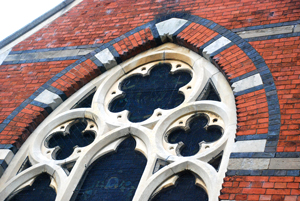
Road Maps and the beginnings of the church
Most surprising, In this backwater of the Midlands, was the importance
in the medieval road system. The Romans had left a street, now called
Ryknield Street, just to the west, but not really in the area. For
many purposes traffic seems to have deserted it for another route,
still much used, represented by Redhill Road to Brockhill Road to
Watery Lane to Portway. That road appears as Mapoldren geat (the
maple tree road) leading to Mappleborough Green in the Saxon boundaries
of Beoley 1. It was later called Paynels Way,
(perhaps after the Paganel family, lords of Northfield in the twelfth
century) in 1289 and 1344 2 and Portway in 1446.
But a more important road is that now represented by Radford Lane
to Hill Lane to Chapel Lane and Station Road. This meandering series
of lanes is actually marked on the oldest existing road map of England,
the Gough map of about 1330, as a route from Droitwich to Coventry.
Identification is made possible by the inclusion of the same route
as part of a road from Hereford to Leicester on Plate 72 on Ogilbys
Britannia, 1675. That quiet cross-road by Hall Farm (the old Weatheroak
Hall) was thus a great junction taking traffic in two directions
by-passing Birmingham. Birmingham itself appears only as a halt
on the route from Droitwich to Lichfield. It is interesting to note
that Wythworth Chapel was thus on the main road of that
time. No positive reference to Alcester Road, Wythall, appears until
much later; it is probably significant that the Gough road crosses
it as if it did not exist.
History does not rise to our bidding. More records have been lost
than now remain and we only marvel that we can find as much as we
do.
Christopher Saxtons maps - the first printed County Maps-are the
earliest definite evidence. In 1576 his Warwickshire map marks Wytho
Chapell and in 1577 his Worcestershire one marks Withe Chap.
The Sheldon tapestry map of about one hundred years later depicts
Witho Chal and the Emmanuel Bowen Atlas of 1763 shows Withorn
Chapel. These curious names are perhaps of abbreviating Wythworth,
or perhaps show the beginning of a lazy pronunciation. None was
ever the real name as they only occur in maps and travel books copied
directly from Saxton.
Few, if any places of worship were founded between the Reformation
and 1576, and it is fair to presume a pre-Reformation origin. Records
of foundation exist in episcopal or papal registers for most late
medieval chapels; thus it is possible, but very cautiously, to suggest
an early medieval date for Wythall Chapel. In these times landowners
were tending to found chapels on their various estates and it is
possible that the de Belnes, who built the chapel at Bell Hall,
Belbroughton, also built one here. Kings Norton, the parish
church, was cut off by the uninhabited area of Kings Wood 3
R J Hetherington
- Birch Cartuliarium Saxonicum 1282.
- Episcopal Registers, diocese of Worcester, register
of Bishop Godfrey Gilfard. 1268.1201. ed. by I. W. Willis Bund
(WHS 1898.1902) p. 335, and Red a~ Worcester cd. by M.~rjorie
HolIin~s WHS. 4 vats. (1934-50) pp. 241-2.
- The hypothetical map below should be referred
to in connection with this chapter.
|